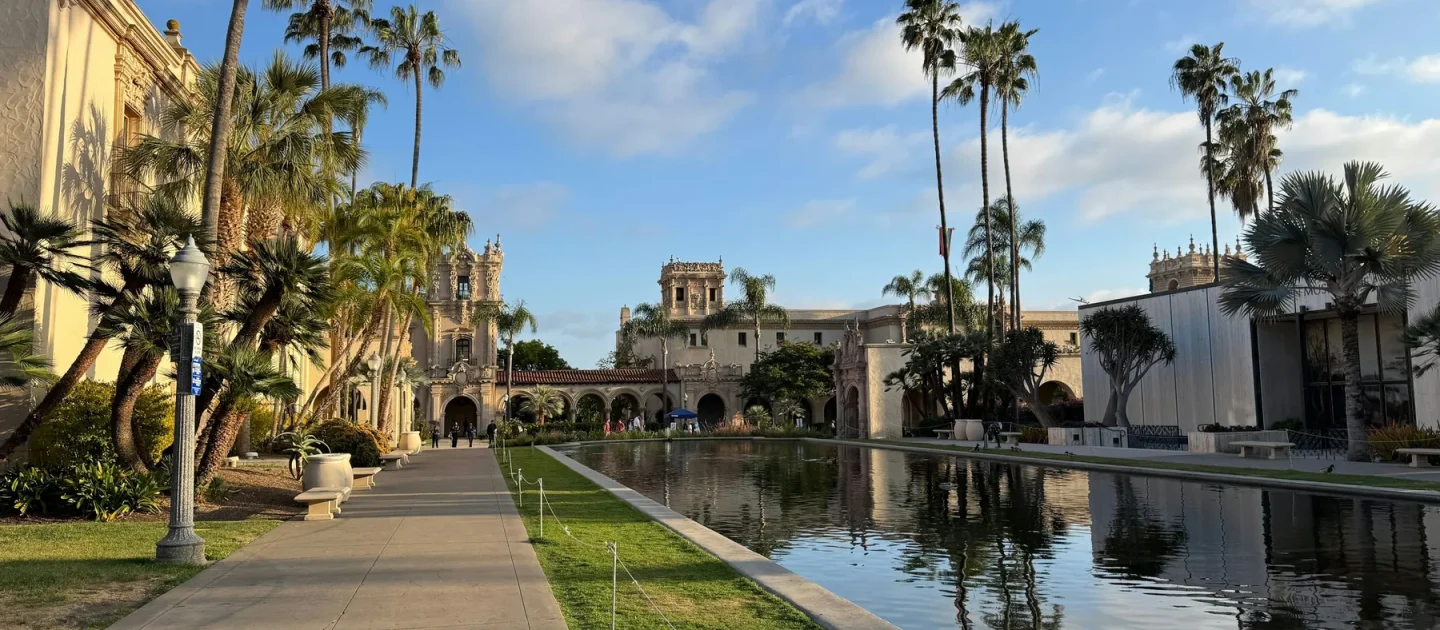
Balboa Park is easy to approach as a collection of façades. The more useful reading begins with movement: long approaches, arcades, gardens, planted shade, museum thresholds, paths, open plazas, and the transitions between formal and informal public space.
Choose an institution, not the whole inventory
A park visit becomes clearer when one museum, garden, performance, or public-space question anchors it. Confirm current access and hours with the institution itself, then leave space for the approach and adjacent landscape. Trying to cover every named place can turn an unusually layered civic environment into a rushed corridor.

San Diego Driving Tour: Gaslamp Quarter, Balboa Park & Old Town
On the San Diego half-day highlights tour, you will visit many of the city’s major historical sites, neighbourhoods and parks, including Balboa Park...

The Story of San Diego's Balboa Park A Walk Down El Prado
Step into the heart of Balboa Park and discover El Prado like never before. This self-guided walking tour invites yo...

San Diego Balboa Park Highlights Small Group Tour with Coffee
Balboa Park is one of San Diego’s most iconic destinations, but with more than 1,200 acres of museums, gardens, an...

Private Balboa Park Segway Tour
Join us in one of the largest urban cultural parks in the US on a Segway tour of San Diego’s Balboa Park. Cover th...
Watch the rhythm of shade and opening
The Prado’s architectural sequence is part of the experience, but it should not be mistaken for the visual language of the whole city. Notice how an arcade frames heat, shadow, view, and circulation. Then compare it with groves, lawns, dry gardens, service streets, and contemporary institutional buildings.
Photography benefits from the same restraint. A close material study may say more than a wide ornament collage. Keep people as users of the park, not scale figures. Respect event rules, artwork rights, and the operations of the institution you are visiting.
Build a breathable route
- Confirm one current institutional anchor.
- Locate the real entrance and transport stop.
- Add one garden or public-space interval.
- Protect time for shade, food, and an unplanned turn.
- End before visual attention becomes a checklist.

2-Hour Downtown and Balboa Tour in GPS Guided Polaris GoCar
This is THE essential San Diego tour and experience it in style with our Polaris GoCar. The GoCar Exotic gets 30 mph...

A Local’s Guide to San Diego’s Sights: A GPS Self-Guided Drive
Designed by a pair of lifelong California residents with a passion for the region’s hidden history, this immersive...

All Day San Diego Tour in the GPS Guided Polaris GoCar
This is the ultimate way to see Everything San Diego has to offer. Tour the city in the world's first storytelling c...
The Story of San Diego's Balboa Park A Walk Down El Prado
Step into the heart of Balboa Park and discover El Prado like never before. This self-guided walking tour invites you to look beyond the beauty and ex...

E-Bike Tour in Balboa Park
On this Balboa Park E-Bike Tour you will learn what San Diego locals know, that Balboa Park is San Diego’s best ke...

The Private Balboa Park Tour
Explore San Diego's Balboa Park with a private guide, and hear informative narration about this 1,200-acre (485-hect...

Viator Exclusive GoCar After Dark: Self-Guided Tour of Gaslamp and Balboa Park
Pick up your E-Sport Vehicle and take a city lights tour through San Diego's famous downtown area. Explore San Diego...
Balboa Park can support a full day or one deliberate chapter. The useful choice depends on the rest of the itinerary, not on the pressure to count buildings.